
TRAFFICSAVIOUR KNOWLEDGE SERIES
What Is Cloaking? A Plain-English Guide for Digital Marketers
If you've been running paid ads for any length of time, you've probably heard the word "cloaking" thrown around — sometimes in hushed tones, sometimes as a buzzword, and almost always without a clear explanation.
The confusion is understandable. Depending on who you ask, cloaking is either a compliance tool, a personalization engine, or a traffic filtering system. In reality, it can be all three — and understanding the difference is what separates marketers who scale confidently from those who get burned.
This guide breaks it down clearly: what cloaking actually is, how it works under the hood, why serious media buyers use it, and what you should watch out for before deploying it in your campaigns.
What Is a Cloaker, Really?
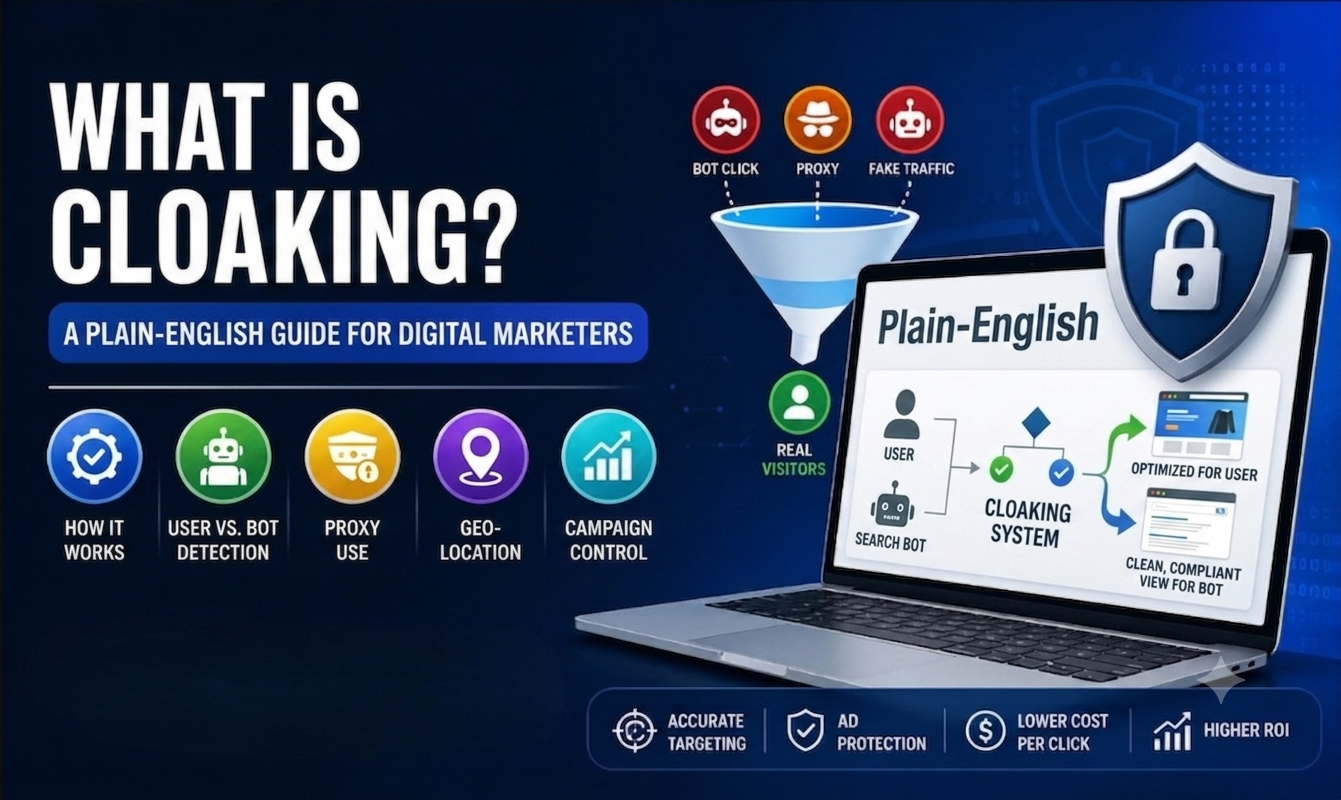
Core Definition: A cloaker — more accurately called a traffic intelligence platform — is a server-side software application that sits seamlessly between a user's click and your landing page destination. Before the webpage renders, the cloaker inspects the incoming request, evaluates dozens of technical signals about that visitor, and instantly executes a secure routing decision.
Think of it less like a curtain and more like a smart receptionist. It's checking credentials in real time and directing visitors to the right room — all in the span of milliseconds, completely invisible to the end user.
How Does Cloaking Actually Work?
Here is the exact technical process that triggers the moment an internet user clicks your online advertisement:
[User Clicks Ad] → [HTTP Request Intercepted] → [Heuristic Engine Evaluates Signals] → [Dynamic Target Page Renders]
- The Inbound Request: The click triggers an HTTP request—before your destination page loads, the cloaker intercepts it.
- Signal Collection Kicks In: The system reads a comprehensive snapshot
of the visitor's technical profile, analyzing variables such as:
- IP Address & Network Type: Distinguishing between Residential, Mobile (3G/4G/5G), Datacenter, or Corporate ranges.
- Geographical Location: Precise location mapping down to the city/ISP level.
- Device Fingerprint: Hardware profile, Operating System (OS), and Browser versions.
- HTTP Architecture: User-agent strings, screen resolution, and language settings.
- Traffic Source Verification: Tracing the click origin (Google Ads, Meta, Native Networks, etc.).
- The Rules Engine Runs: Those signals are cross-referenced against pre-configured administration rules and global real-time bot databases.
- Routing Happens Instantly: The visitor lands on whichever page matches their profile. A verified human from your target market sees your optimized offer. An automated crawler, ad reviewer, or competitor spy tool sees a clean, compliant page instead.
The whole process takes less time than a standard page load. Your real visitors never notice a single delay.
Why Do Marketers Use Cloaking?
Modern ad traffic is incredibly messy. You're not just getting clicks from interested buyers — you're dealing with automated scrapers, platform compliance reviewers, and competitive intelligence tools.
Running all of that through the exact same landing page structure is highly wasteful. Professional marketing teams turn to traffic intelligence for four main reasons:
- Protecting Ad Spend from Bots and Click Fraud: Click fraud is a real and costly problem across ad networks. Automated bots inflate click counts, drain budgets, and corrupt your analytical funnels. A traffic intelligence layer filters invalid clicks before they ever touch your marketing stack, ensuring your ad spend reaches real human beings.
- Personalizing by Geography: If you're running global campaigns across multiple markets, one generic landing page won't cut it. A visitor from Germany has different pricing expectations, legal requirements, and language preferences than a visitor from Brazil. Cloakers enable native geo-personalization at scale without duplicating entire campaigns.
- Keeping Analytics Clean: When ad network crawlers, internal reviewers, and competitors hit your pages, they pollute your pixel data and conversion optimization metrics. By routing non-human traffic separately, you get clean performance metrics that actually reflect authentic buyer behavior.
- Running Clean A/B Tests: Competitive spy tools scrape winning landing pages constantly. If a competitor can see every landing page variation you're testing, your competitive edge disappears. Traffic filtering keeps your test variations visible exclusively to real visitors, protecting your proprietary creative advantage.
Cloaking Has Changed — Legacy Tools Are a Liability
Early cloakers were blunt instruments. They relied on static IP blacklists and basic user-agent pattern matching. That worked for a while — but modern ad networks have evolved dramatically. Today's platform crawlers utilize cloud-native infrastructure, rotate dynamic IPs, simulate true human behavior, and easily defeat old-school filtering logic.
Modern traffic intelligence is a completely different category. Instead of checking one or two isolated signals, it evaluates hundreds of overlapping indicators simultaneously, utilizing machine learning and behavioral heuristics to distinguish a real buyer from a sophisticated headless bot.
Traditional vs. Modern Traffic Management
| What's Being Compared | Legacy Cloaking | Modern AI Traffic Intelligence |
|---|---|---|
| Detection Method | Static IP lists + basic user-agent tracking | Real-time behavioral heuristics + Machine Learning |
| Signals Evaluated | 1–2 isolated parameters | Hundreds of aggregated signals in real time |
| Routing Speed | Redirect-heavy, causes latency | Edge-computed routing in milliseconds |
| Bot Sophistication Handled | Basic scrapers only | Headless browsers, Selenium, Puppeteer patterns |
What You Need to Know Before You Deploy
Traffic intelligence applied to bot filtering, geo-personalization, and analytics protection is a legitimate, widely-used practice in professional digital marketing. It improves programmatic efficiency, protects margins, and enables precise consumer targeting.
That said, using any routing technology to actively mislead ad platforms carries real enforcement risk, including permanent account suspension. The distinction matters, and reputable platforms are built with compliance boundaries in mind.
TrafficSaviour: Built for Marketers Who've Outgrown Basic Tools
If you're scaling ad campaigns and need a traffic intelligence layer that's actually built for the complexity of modern paid media, TrafficSaviour is the industry-standard solution worth a serious look.
What TrafficSaviour brings to your deployment stack:
- AI-Driven Visitor Profiling: Analyzing behavioral footprints and deep device integrity metrics in real time.
- Proactive Invalid Traffic Detection: Instantly catches ad fraud, scrapers, and platform spy networks before they touch your budget.
- Low-Latency Geo Intelligence: Serves hyper-localized landing page variants instantly tailored to each market segment.
- Real-Time Analytics Dashboards: Absolute visibility into traffic authenticity, allowing you to optimize campaigns with clean, unpolluted data.
Want to see how traffic intelligence applies to your specific ad channels and markets? Explore what TrafficSaviour can do for your campaigns today.
 Support
GitHub
Support
GitHub