
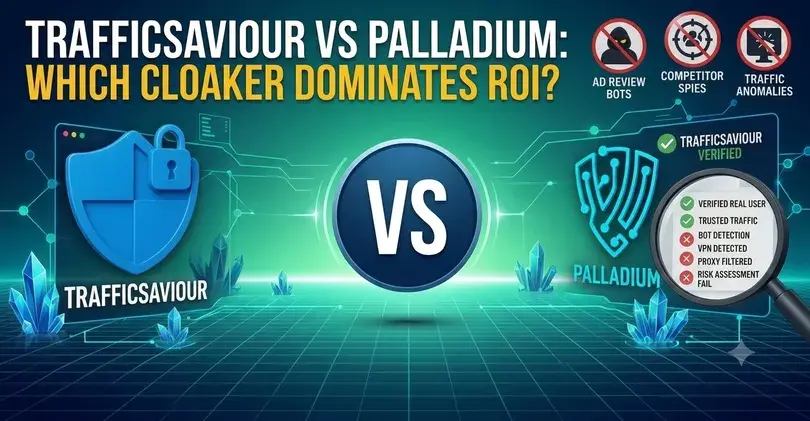
While TrafficSaviour is intended for large advertisers that require immediate browser-based bot detection on TikTok, Google and Meta platforms, Palladium will be a perfect solution for small teams that prefer simple IP and device filtering at a reduced cost of entry. However, in most cases, the behavioural layer of TrafficSaviour is more efficient in detecting sophisticated invalid traffic, but it depends on several factors such as the budget and traffic volumes.
What Should a Modern Traffic-Quality Platform Actually Do?
The current traffic quality solution doesn’t merely filter out IPs on the blacklist — it is supposed to assess the visitor according to several criteria and then make the decision based on this assessment. Once a click gets registered, the typical sequence of criteria checked usually includes:
- Geo and IP address
- Device and OS
- Browser and ISP
- Status as VPN or proxy
- Referrer and language
- Frequency of clicks from one source
- Blacklist and whitelist status
When it comes to media buying, functionality is less important than speed of configuration for every campaign. If every new flow takes hours of manual configuration, such a solution will become a bottleneck at any attempt to scale.
What Is Traffic-Quality Filtering, and Why Does ROI Depend on It?
- The traffic quality filter is used to distinguish between human clicks, which are legitimate buyers, and bot clicks, which are scrapers and fake traffic before they eat away at your budget. Without traffic filtering, non-human clicks will be indistinguishable from actual ad interest in your ad dashboards, as they fail to materialise into conversions.
- It is relevant due to the fact that invalid traffic is not some marginal problem anymore:
- Global advertising fraud will cost advertisers $100.2 billion in 2026, placing it among the top financial risks in digital marketing.
- According to independent analysis of more than 100 billion programme impressions, the percentage of invalid traffic was approximately 20.64%—which translates into one out of every five impressions failing to see human eyes.
- Bad bots accounted for 37% of total web traffic in 2024, compared to 32% in the previous year, as per Statista figures reported by Fraud Blocker.
Filtering out this traffic protects three things at once, which is exactly why ad fraud prevention tools have become a standard part of any serious media-buying stack:
- Ad dollars – money spent on clicks that are not even worth anything.
- Account status – less risk of manual review or flags.
- Data quality – optimisation models learn on data from genuine users, not bots.
TrafficSaviour vs Palladium: Feature Comparison
TrafficSaviour uses real-time behavioural analysis to flag suspicious visitors, while Palladium relies primarily on IP and device-signature databases. Both approaches are legitimate parts of a traffic-quality stack — they just catch different things and suit different scales of operation.
| Parameter | TrafficSaviour | Palladium |
|---|---|---|
| Detection method | Behavioural analysis + script monitoring | Automated IP/ASN reputation scoring |
| GEO filtering | Detailed, combinable with other signals | Standard |
| VPN/proxy detection | Yes | Yes |
| Device & OS filtering | Yes | Yes |
| Browser / ISP / Referrer | Yes | Yes |
| Custom blacklist / whitelist | Yes | Limited |
| Update frequency | Real-time cloud sync | Scheduled database updates |
| Reporting | Campaign, device, and geo-level dashboards | Standard traffic reports |
| Setup complexity | Moderate — script + dashboard config | Low — mostly plug-and-play |
| Best fit | High-volume, multi-platform scaling | Smaller teams, single-network buying |
| Start Pricing | $45/Month | $100/Month |
Pricing and exact feature limits change over time, so confirm current plans directly on each provider's site before committing.
GEO Filtering: Why Granularity Matters at Scale
The same offer will behave completely differently in the US, Germany, France, or even in Tier-3 GEO – that’s why using only GEO filtering will hardly give good results. The key point is if GEO filtering could be used in conjunction with other criteria in one single filter.
For instance, you can use such filters as:
Country + device + OS + browser + language + timezone instead of using them one by one.
It will hardly play a role when you’re running a single small campaign. But when you’re having dozens of campaigns and you’re targeting several GEOs at the same time, this level of segmentation will become critical.
Integration and Launch Speed
The time it will take to get from sign-up to your first test is just as important as the detection capabilities themselves. The classic solution – integration through domain name, hosting, and script – does the job perfectly for technical teams but causes extra steps for those who test multiple offers, sources, and GEOs.
What you want is a platform that gives you the flexibility of selecting the integration level you need:
- Quick setup for fast testing, with hosted or minimal configuration.
- Full integration (with your own domain, server-side installation) when a tested campaign is ready to scale.
The ability to start light and expand your infrastructure later can be a huge benefit for testing multiple campaigns simultaneously.
How TrafficSaviour Improves Campaign ROI
- Behavioural signals: Analyses behavioural signals rather than the IP origin and identifies automated visits which seem like human visits.
- Real-time: Cloud-based detection ensures there is no delay between the discovery of the threat pattern and protection of the campaign.
- Cross-network reporting: Centralised report on the traffic from TikTok, Google and Meta campaigns.
Analytics and Click-Level Visibility
Working without analysis implies working blindly – there should be more to blocking the traffic than knowing about it; you must understand the reason for blocking and verify the correctness of your decision.
The right view on the data for analysing includes information about each click:
- IP and GEO
- Device and browser
- ISP and referrer
- Which filter triggered
And it forms the loop that should be implemented in your regular workflow: traffic -> filtering -> analysis -> assessment -> tuning -> testing. The quicker the loop works, the easier it is to spend money safely.
Step-by-Step Guide to Setting Up Traffic-Quality Filtering
- Integrate your advertising accounts. Connect TikTok, Google, and Meta campaigns using IDs and UTM parameters so that traffic can be tracked accurately.
- Set your fraud detection parameters. Decide on how conservative bot and VPN filtering will be; too conservative parameters can result in blocking of legitimate mobile or VPN users.
- Specify your geographic and device settings. Define countries, languages, and devices you would like to deliver the ad to, according to your real audience’s geography.
- Check the suspicious traffic daily. Analyse logs during the first two weeks of your campaign so your settings are calibrated according to your real traffic.
- Verify the conversions before increasing the budget. Make sure your conversions look legitimate before increasing your budget so you wouldn’t be scaling budget into fraud.
Common Mistakes That Hurt ROI
- Overlooking database/model updates. Old rules miss out on detecting new bot behaviour.
- Setting the threshold too harshly. Too much blocking excludes legitimate users using a VPN or multiple devices connected to the same mobile network.
- Equal treatment of all networks. Different companies have different traffic behaviour – a single static rule will not work effectively for all of them: TikTok, Google, and Meta.
- No audit of conversion data. Not performing an audit regularly allows for fraud to boost conversion rates for weeks unnoticed.
Advanced Tips for Long-Term Traffic Quality
- Layer Detection Techniques. The combination of IP-based and behaviour-based filtering techniques detects more fraudulent clicks than using any one technique alone.
- Segmenting Reports by Channel. By segregating and analysing reports for TikTok, Google, and Meta channels, it becomes easy to identify which platform sends clicks of lower quality.
- Update Thresholds Monthly. Click patterns change as fraud techniques change; hence, the “set and forget” configuration becomes less effective over time.
Frequently Asked Questions
TrafficSaviour’s behavioural detection will likely work fine on TikTok due to the way traffic on the platform behaves, while Palladium still makes for a decent and affordable choice for smaller TikTok ad campaigns.
No solution can ensure the absence of invalid traffic, as fraud practices and detection techniques keep developing. Continuous filtering can minimise the loss of budget funds, but complete prevention is not possible.
IP filtering filters out IP addresses that have been blacklisted as part of proxies, data centres, and flagged networks. Behavioural filtering analyses the behaviour of a visitor on the page — clicking, scrolling, loading times, and other interactions — to determine whether the traffic is real.
There is variation between channels regarding industry estimates. However, the analysis of large program data sets shows that there might be 20% or more invalid traffic depending on the category. Your exact percentage will vary based on the platforms you use and your targeting approach.
In case of small-scale campaigns using one platform, the IP-based detection process by Palladium works well, and the more budget you have for your campaign and the more platforms you use, the more efficient the method becomes. However, in case of large amounts of traffic on one platform, the behaviour detection system used by TrafficSaviour is more effective to use.
About the Author
Advised by the TrafficSaviour Ad Compliance Team, who specialise in traffic quality analysis and fraud detection across TikTok, Google, and Meta advertising since 2024. This team has coached performance marketing teams working with multiple ad platform budgets to set up their scalable traffic filtering systems.
 Support
GitHub
Support
GitHub